Fields
On boyhood

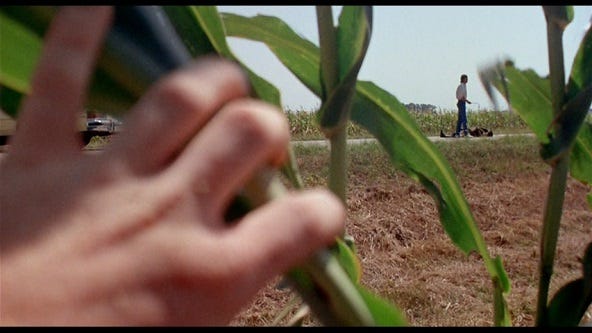
Lately I’ve been dreaming about the cornfields at the end of the road I grew up on. Not in my sleep, but behind my eyes while I’m awake — neither quite memories nor fantasies, just a roil of images that bubble up whenever I have a spare moment. In the long summers of my childhood, we’d walk just five minutes down the road until all the other little one floor ranch-style houses petered out and were replaced by the long stretches of green and golden stalks swaying in the breeze. The corn marked the boundary of the city proper, beyond it rural villages with names like Mount Hope and further down past the airport, Six Nations — the largest First Nations reserve in Canada, a place only visited riding shotgun when my Dad went to buy ziplocks full of cigarettes to stick in the freezer. Standing on the cracked and potholed tarmac road, we’d stop and stare into the dense rows of corn, massive hydro towers looming over us, wondering what might be in there, convinced we saw shadows moving between the leaves.
There was no farm around that we could see, you’d have to go farther than either of us would want to bike to hit the real farmland, though in retrospect it wasn’t actually all that far away. Who owned all that corn and who came to collect it every year? I don’t remember even once, in the twelve years we lived there, having seen combines reap, thresh, and winnow their way through those stretches of crop. There were no scarecrows, or really any sign of human life. It seemed to happen all on its own overnight. One day there was a dense maze of vegetation twice the height of us, the next it was gone. Probably, it just happened while we were in the elementary school across the road from our houses. But the vanishing that marked the true end of summer lent it all an air of mystery.
Cam always wanted to drop our bikes on the side of the road and wander in, let the rows of corn absorb us. He was my last boy friend before every boy decided I was too gay to hang out with, and lived just a few doors down in a house full of Elvis memorabilia, velvet paintings, and his sister’s horse trophies. I’d learned to bike just to keep up with him. We rode around all day, camped out in our backyards, and watched an endless stream of horror movies in his basement. I was up for nearly any of them, but I’d make him put The Exorcist VHS outside whenever we had a sleep over. When we played X-Men on his trampoline, he never gave me shit for being Storm or Jean Grey, and I was always Storm or Jean Grey. He got to be Wolverine without a fight, so it worked out pretty good from his perspective. The only thing we had in common was that Cam and I both loved pushing boundaries — he stole copies of his father’s Penthouse Forum and we hid them in a bush to take turns reading later; and I, obviously, was a girl in every game — but the cornfields were where I drew the line. We’d watched Children of the Corn and I was convinced that something terrible was waiting just behind the first few rows, watching us, hoping we’d be dumb enough to walk right to it.
I had good reason to believe that something awful might snatch one of us up. The year before, my house had been shaken by clashing waves of anxiety. When I crossed the road after school, my parents had gathered me up and sequestered me in another room while all of the adults were running around, wringing their hands, police filing in and out of the living room. Later my mother would come find me and tell me that a man had “tried” to abduct my older brother as he waited one street over for the bus to take him to middle school. Only as an adult have I pieced together that this version of the story is the one you tell an eight year old, perhaps not the full picture. But it was enough, along with the fact that the perpetrator was never caught, to deepen every dark corner in our sun-drenched neighbourhood.
Sometimes to scare me, Cam would run full tilt into the fields. Only once or twice, after waiting, listening for any sign of movement, did I follow after him. Hesitant, I would step down off the tar road, hop across the ditch thick with weeds, and push my way between the tall stalks. In the winter, you could tell that the giant hydro tower was just twenty or thirty feet in from the road, but in the thickness of summer, with the corn rising up higher than I could reach my arms above me, I became immediately disoriented. This was another fear of the fields: that they were big enough that you could get lost in them. Or, at least, a kid my size might. In movies, corn fields are in neat, regular rows. But in my child’s memory, it was a forest, a totally unpredictable terrain. Panic picked at the edges of my mind as the leaves rustled around me. But if I called out Cam’s name, if he heard a tremble in my voice, that would mean losing somehow — to lose that same indefinable something I always lost where boys were concerned. I had to wade through the stalks until he jumped out at me, laughing, yelling “CHILDREN OF THE CORN! CHILDREN OF THE CORN!”
Those transformers, the hydro towers that stretched farther than we could see in both directions, were something else to worry about. One or the other of us knew that if you touched them, you’d get electrocuted. People on TV got electrocuted all the time. In cartoons, they turned into an x-ray and then sizzled and smoked. On the news, kids had their arms burned clean off after grabbing live wires. Any time we went to the corn fields, the low hum of the hydro towers warned us not to get too close. To this day I may no longer be certain that touching the metal structure means instant death but, whenever I walk past the transformer in Hackney Marshes, I keep a wide berth.
We must’ve been only friends for a few summers until Cam went off to middle school. There he found real boys to hang out with, loud and aggressive and constantly jostling each others’ tight cropped Caesar cuts and frosted tips, while my black hair grew longer and longer. One day I saw the moment it happened, the moment he realized that he couldn’t have me around them. They were laughing at something and he was laughing with them and then he looked at me. Some shadow passed behind his eyes. And I knew that he wasn’t going to come knock on the back door anymore or climb in my bedroom window. With the new boys to contrast, he finally saw that thing in me that everyone else saw plainly.
After he disappeared from my life — still just a few doors down, but in a different dimension entirely — I stopped riding my bike but I still wandered up the road. Sometimes I’d go past the cornfields to the wild patch of trees and bushes where we’d once dragged a large sheet of plywood up into the only branches strong enough to hold it, a makeshift treehouse we could barely sit in, and I’d climb up onto it by myself to read books and daydream about becoming Xena: Warrior Princess.
Maybe it was walking back from there that it happened. I don’t remember. What I remember is the fear. What I remember is the group of them, yelling on their bikes, following me. What I remember is turning the corner down my street, boxed in on either side by the strange and unsettling cornfields, and knowing that I didn’t have a lot of time before they caught me. Were they coming to hurt me or just insult me? What I remember is only that I did not want to be found. What I remember is backing myself into the crops, letting the papery leaves and stiff stalks envelop me. As I walked backward, low to the earth, certain that I couldn’t get turned around and lost forever if I kept my eyes in the direction of the road, the corn blotted out the known world, dampened the sound of the boys as they flew past. Sitting on my haunches, I knew then that I was not of them and never would be. I became the shadow in the cornfield. I was the terrible creature lurking between the rows. And for once I wasn’t afraid.
Some fun project announcements coming soon, but in the meantime I hope you enjoy this little bit of autofiction. xx MMP
What a beautiful piece of writing!
This is gorgeous and, as someone who grew up a little freak in rural Ontario, deeply resonant 💜